My life would be very difficult without 'command F'.
Honestly. By pressing 'command F' (or ‘control F’ if I’m not using my mac) I
can find the most important information in the click of 2 buttons regarding any
topic in a document or website. Without it, I would be spending so much of my
time reading things that are unimportant and aren't related to topics. It
leaves me more time to answer emails, write reflections such as these, as do
even more research! – This idea came from the videos of all the students
commenting on what life is like now for students.
Wednesday, 4 March 2015

Tuesday, 3 March 2015
Reflections from a ted talk, someones blog, and some research!
While checking my Feedly feed this morning I came across an awesome TED talk (I'm loving the excuse to watch TED talks). Jon Gosier talks about the impact that technology is having on the world. He mentions that the more e use technology to innovate our lives and make our lives easier, the more we are actually oppressing those who don't have access to the technologies we do. He uses an example from a medical perspective to illustrate this. He mentions that the more we use technology to record our medical information, the more we are restricting our ability to treat people effectively who don't have access to technology. The people who are still using pen and paper to record medical information in the years to come, will be disadvantaged in time and resources compared to those who have their medical records available at the touch of a button.
Does this translate in education? Are we oppressing those in third world countries and restricting their learning because we are so much more advanced? Think of the refugees that are coming to our country, who are having to catch up not only on language and academic skills, but also the technological skills as well.
Jon says that we innovate technology around the world based on the assumption that everyone will have access to the innovation. He also says that we need to think less about efficiency and more about efficacy. We need to think of the global outcomes of our actions. The link to Jon's TED talk is here.
This TED talk lead me to think about what would happen if we moved to a Bring Your Own Tech (BYOT) initiative. It lead me to think about the global impacts of the BYOT movement. If all of Australia, the USA and UK created this initiative, would we have some schools, or areas that are disadvantaged by this movement because they can't afford to buy technologies? I did a little bit of research, and I couldn't find the answer to this specifically, however, an article I found lead me to think about the impact this has on teachers. Cardoza and Junks (2014) investigated teachers concerns regarding this movement. They found that teachers are mostly concerned with their own ability to use technology, the amount of preparation time needed for lessons with a technology focus and also the lack of professional development.
I thought about my experiences regarding technology use in schools. n regards to professional development specifically, I remembered that on my first prac, they didn't have professional development as such, but rather in each staff meeting, a teacher would share a new tool or experience that they found using the technologies they were using.
In saying this, teachers should consider adopting a growth mind set when undergoing and investigating new technologies (follow this link to Laureena's blog that talks about the growth mind set). I specifically like Laureena's mention of the impact that the teacher mindset can have on student mindsets regarding the use of ICTs.
I think my random spurts of research and thinking has opened up more questions than answers for now. Are we disadvantaging some people because our use of technology is advancing? Will the BYOT movement increase this disadvantage? Do we need to do more professional development for all teachers regarding the use of ICTs? Or is an 'in house' sharing method just as efficient? How important is the growth mindset for teaching and learning about ICTs?
Cardoza, Y. & Tunks, J. (2014). The bring your own technology initiative: An examination of teachers' adoption. Computers in the Schools, 31(4), 293-315. doi:10.1080/07380569.2014.967626
Students creating websites to transform their learning
Today, in the EDC3100 lecture we were briefly introduced to the website below.
http://www.wix.com/website/templates
After investigating the website (which is a free website that students can make websites on ... yeh confusing) I thought I would have a go at applying the TEST framework to help me deduce how I would use this website in my teaching, how it could benefit learning and what I would need to think about when using this learning tool in my classroom. Potts (2011) research of creating online material through websites and other mediums found that "creating and sharing material was a positive and enjoyable experience" (p. 610).
Task:
The task associated with this website, would be for students to create a website. Students may create websites for any number of reasons. I was thinking of using it as a tool for students to analyse a ritual using various frameworks and think about how they could present this information in a Study of Religion class. I also thought about using it as an assessment instrument to test students abilities to create an informative website regarding renewable energy, or some other concept in science. Ultimately, the options are endless.
Environment:
What environment do we need to be in for this to work? - I think this is the easiest question to answer.. a classroom, or the students study area at home. Students can access this information and work on the task anywhere that they can gain access to wifi.
Skills:
Some of the skills students may need include being able to navigate a website, be able to communicate in an appropriate manner on the internet, being able to design how the layout will look, be able to synthesise and also categorise information in a way that is easily communicated and flows. students also need to be able to use content on the internet appropriately in terms of copyright (Potts, 2011, p. 608).
Tools:
Tools that could help me teach students how to use this technology may include videos that describe how to navigate the website that creates websites. The internet can be helpful to troubleshoot for students who are stuck and also myself. The other students in the class who have made websites before can also work with the other students to help them create their websites. The teacher will also need resources to help discuss copyright laws.
Reference
Potts, H. W. W. (2011). Student experiences of creating and sharing material in online learning. Medical Teacher, 33(11), e607-e614. doi:10.3109/0142159X.2011.610839
http://www.wix.com/website/templates
After investigating the website (which is a free website that students can make websites on ... yeh confusing) I thought I would have a go at applying the TEST framework to help me deduce how I would use this website in my teaching, how it could benefit learning and what I would need to think about when using this learning tool in my classroom. Potts (2011) research of creating online material through websites and other mediums found that "creating and sharing material was a positive and enjoyable experience" (p. 610).
Task:
The task associated with this website, would be for students to create a website. Students may create websites for any number of reasons. I was thinking of using it as a tool for students to analyse a ritual using various frameworks and think about how they could present this information in a Study of Religion class. I also thought about using it as an assessment instrument to test students abilities to create an informative website regarding renewable energy, or some other concept in science. Ultimately, the options are endless.
Environment:
What environment do we need to be in for this to work? - I think this is the easiest question to answer.. a classroom, or the students study area at home. Students can access this information and work on the task anywhere that they can gain access to wifi.
Skills:
Some of the skills students may need include being able to navigate a website, be able to communicate in an appropriate manner on the internet, being able to design how the layout will look, be able to synthesise and also categorise information in a way that is easily communicated and flows. students also need to be able to use content on the internet appropriately in terms of copyright (Potts, 2011, p. 608).
Tools:
Tools that could help me teach students how to use this technology may include videos that describe how to navigate the website that creates websites. The internet can be helpful to troubleshoot for students who are stuck and also myself. The other students in the class who have made websites before can also work with the other students to help them create their websites. The teacher will also need resources to help discuss copyright laws.
Reference
Potts, H. W. W. (2011). Student experiences of creating and sharing material in online learning. Medical Teacher, 33(11), e607-e614. doi:10.3109/0142159X.2011.610839
Introverts = extraverts online... and vice a vice!
I was pondering in class how the introverted and extroverted students in our classes would react to all this technology. I know myself that I'm a bit of an Ambivert.. so I have a nice mix, I can choose when I want to be extraverted or introverted! Get me in front of a class and I can be as extraverted as you want me to be, but see me 5 minutes after class and I will be hastily reflecting on what I did and need some quiet time to think. I have met plenty of students from the whole range of introvert to extravert. I did a quick research of some reactions from introverts and extraverts on social media and also in academics.

Just pondering the above image, I would have assumed that the extraverts would thrive in a stimulating online environment, however, after reading some articles (below) I found that it seems to not be the case.
This article says that extroverts sometimes find it hard to be on a computer all day and therefore don't like social media, they prefer to be out and about. Where as introverts can really thrive in the online environment. I would deduce that this is because they feel more free to express themselves, and can use social media as a tool to filter who they interact with and how much they want to share without feeling like they are being judged. The author describes in another article that
the rise in social media also means that people are glued to their screens and do not want to talk. That means that extroverts will not be as stimulated by discussion and may feel a bit lost.
I also found from Deryakulu, Büyüköztürk and Özçınar (2009) that 'introverted assimilators' thrive in the academic environment and tend to achieve better academically.
Upon reflection, I think that in a class I would have to gage whether it is necessary to cater for the introverts and allow them to thrive through using social media and other information sharing mechanisms, or whether I would need to cater for the extroverts with face to face discussion.
Reference
Deryakulu, D., Büyüköztürk, Ş., & Özçınar, H. (2009). Predictors of academic achievement of student ICT teachers with different learning styles. Anxiety, 8, 0-79.
Thursday, 26 February 2015
How I've used YouTube in my maths class
While on prac last year, I provided my mentor with a list of things that I wanted to experiment with in the classroom and improve on. One of the things on my list was using ICTs in maths.
My mentor said 'yeh sure, go ahead'. So I jumped at the chance and looked for some inspiration for what I could experiment with.
I'm a massive fan of Sal Khan and what he's done created with Khan academy (for his TED talk on using video to reshape education, click here). I brainstormed a little and thought about how I could use this tool to guide student's through worked examples in maths. I decided to parody my own version of a Khan academy video. I used the screen recording software on quicktime player to record my screen, I used my wacom to draw onto my paintbrush software, and put it all together using garageband! - How's that for using ICTs. The result was this YouTube video.
I found that the male students engaged more with the technology, and I was able to then go and work with them individually if they got stuck. The female student's didn't engage with it as much, and preferred for me to run the information through it again with them on the board.
The students were very used to a strict structure of taking notes and learning through going through worked examples in the board and as a result have the opportunity to discuss and develop a conceptual understanding of the topic before they use ICTs to learn. To improve, I would have focused more on making sure the communication that was presented was similar to that of what is expected when they complete questions on tests and that there was also a deeper discussion regarding the formula and theory. Stacey (2005) supports that this method could be useful when helping students to develop an understanding of the appropriate use of ICTs. Stacey (2005) mentions that one of the teachers in their study of the use of calculators stated that they wanted students to develop a strong conceptual understanding by doing simple calculations by hand before using technology to understand concepts. This aims to allow students to develop and understanding of when it is appropriate to use technology. Therefore, by stepping students through the working out 'manually' before students use ICTs they have the opportunity to develop a conceptual understanding. I would also consider introducing new topics face to face, and then providing the YouTube video to students who need to catch up and review the worked example later on.
I did encounter a problem where one student that did not have access to the internet. It it essential to consider that some students live in situations where they can not access ICTs and it is essential to make accommodations for these student's. From the perspective of ensuring that all students have the opportunity to access technology and learning equally, I would have perhaps reconsidered the activity, and in the future modify the task to allow the student an equal opportunity to learn.
From this reflection, I have developed more of an understanding as to how the use of ICTs needs to be ethical and cater to all students. It also needs to ensure that students are learning to the best of their abilities, which may require task modifications.
Stacey, K. (2005). Accessing results from research on technology in mathematics education. Australian Senior Mathematics Journal, 19(1), 8-15.
My mentor said 'yeh sure, go ahead'. So I jumped at the chance and looked for some inspiration for what I could experiment with.
I'm a massive fan of Sal Khan and what he's done created with Khan academy (for his TED talk on using video to reshape education, click here). I brainstormed a little and thought about how I could use this tool to guide student's through worked examples in maths. I decided to parody my own version of a Khan academy video. I used the screen recording software on quicktime player to record my screen, I used my wacom to draw onto my paintbrush software, and put it all together using garageband! - How's that for using ICTs. The result was this YouTube video.
I found that the male students engaged more with the technology, and I was able to then go and work with them individually if they got stuck. The female student's didn't engage with it as much, and preferred for me to run the information through it again with them on the board.
The students were very used to a strict structure of taking notes and learning through going through worked examples in the board and as a result have the opportunity to discuss and develop a conceptual understanding of the topic before they use ICTs to learn. To improve, I would have focused more on making sure the communication that was presented was similar to that of what is expected when they complete questions on tests and that there was also a deeper discussion regarding the formula and theory. Stacey (2005) supports that this method could be useful when helping students to develop an understanding of the appropriate use of ICTs. Stacey (2005) mentions that one of the teachers in their study of the use of calculators stated that they wanted students to develop a strong conceptual understanding by doing simple calculations by hand before using technology to understand concepts. This aims to allow students to develop and understanding of when it is appropriate to use technology. Therefore, by stepping students through the working out 'manually' before students use ICTs they have the opportunity to develop a conceptual understanding. I would also consider introducing new topics face to face, and then providing the YouTube video to students who need to catch up and review the worked example later on.
I did encounter a problem where one student that did not have access to the internet. It it essential to consider that some students live in situations where they can not access ICTs and it is essential to make accommodations for these student's. From the perspective of ensuring that all students have the opportunity to access technology and learning equally, I would have perhaps reconsidered the activity, and in the future modify the task to allow the student an equal opportunity to learn.
From this reflection, I have developed more of an understanding as to how the use of ICTs needs to be ethical and cater to all students. It also needs to ensure that students are learning to the best of their abilities, which may require task modifications.
Stacey, K. (2005). Accessing results from research on technology in mathematics education. Australian Senior Mathematics Journal, 19(1), 8-15.
Saturday, 21 February 2015
Reflection on the use of Popplet
For my own personal learning, I just finished creating a popplet to help me plan for an essay.
I just wanted to reflect on the experience and how I could use this in a classroom.
Although I didn't explore all of the functions (which I intend to do in the future) I was able to create a type of mind map that eventually lead me to be able to write a hypothesis for an essay.
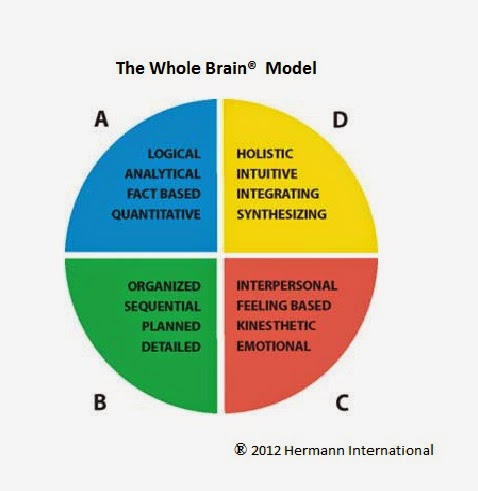
I understand that my beliefs and values regarding how an essay or report should be written are quite firm and structured. I 'do' with my 'logical' brain. That is I'm a left brain-doer. That means I like to write lists and have everything sequenced. Therefore this process is a little outside of my comfort-zone as it requires the user to think about how the information could be interconnected as opposed to sequenced. However, for the right brain-thinker.. or the creative thinker, if you like, this would be perfect as it allows for flexibility and integration of creative ideas. Jennifer McIntyre covers this theory of the brain in orientation week at USQ, however, this images summarises the above. Green is the 'left brain doer' and yellow is the 'right brain thinker'.
In terms of where I could use this in the classroom, I could integrate it into an assignment preparation activity, as an inquiry tool for science and understanding the interrelatedness of concepts or to help breakdown and categorise formulas in maths.
Does anyone have any ideas of activities that you could run in a history/religion classroom?
Alice
I just wanted to reflect on the experience and how I could use this in a classroom.
Although I didn't explore all of the functions (which I intend to do in the future) I was able to create a type of mind map that eventually lead me to be able to write a hypothesis for an essay.
I understand that my beliefs and values regarding how an essay or report should be written are quite firm and structured. I 'do' with my 'logical' brain. That is I'm a left brain-doer. That means I like to write lists and have everything sequenced. Therefore this process is a little outside of my comfort-zone as it requires the user to think about how the information could be interconnected as opposed to sequenced. However, for the right brain-thinker.. or the creative thinker, if you like, this would be perfect as it allows for flexibility and integration of creative ideas. Jennifer McIntyre covers this theory of the brain in orientation week at USQ, however, this images summarises the above. Green is the 'left brain doer' and yellow is the 'right brain thinker'.
In terms of where I could use this in the classroom, I could integrate it into an assignment preparation activity, as an inquiry tool for science and understanding the interrelatedness of concepts or to help breakdown and categorise formulas in maths.
Does anyone have any ideas of activities that you could run in a history/religion classroom?
Alice
TEST analysis on an issue.
I can’t remember where to find where something is on the Study Desk?
Story of my life! I think the issue with this course specifically is that there are no PDF's (I love PDF's, because I can download them and save them in my own folders etc). Even though the course is set out spectacularly well, there are links within books and it can get very confusing.
Here's my TEST analysis to see if I can solve the problem.
Task:
What is the task/problem?
The task is to find something on study desk that is REALLY important.
Environment:
Where is the task meant to take place?
I find that while I'm studying, even though this subject has a lot of online content that can 'be accessed anywhere, at anytime, on any device' I still like to do my work on a desk AND with a pen and paper open to take notes.
Also the online environment is the study desk.
Skills:
What skills to I need?
Navigational/retrieval skills I think sums up what we need to be able to do here.
Tools:
- The search tool for forums can be a huge help if you are after something one particular person said.
- Pen and paper- If something you think is really important, why not jot down in your notepad "assignment info- under assignment tab, cover sheets and structure sheets are down the bottom. also downloaded into assignment 1 folder on USB". Or, for each new book not down the title and subheadings in each as a personal map to the study desk.
- There are also plenty of online tools such as the Diigo tool that can help to locate information at a later date.
Story of my life! I think the issue with this course specifically is that there are no PDF's (I love PDF's, because I can download them and save them in my own folders etc). Even though the course is set out spectacularly well, there are links within books and it can get very confusing.
Here's my TEST analysis to see if I can solve the problem.
Task:
What is the task/problem?
The task is to find something on study desk that is REALLY important.
Environment:
Where is the task meant to take place?
I find that while I'm studying, even though this subject has a lot of online content that can 'be accessed anywhere, at anytime, on any device' I still like to do my work on a desk AND with a pen and paper open to take notes.
Also the online environment is the study desk.
Skills:
What skills to I need?
Navigational/retrieval skills I think sums up what we need to be able to do here.
Tools:
- The search tool for forums can be a huge help if you are after something one particular person said.
- Pen and paper- If something you think is really important, why not jot down in your notepad "assignment info- under assignment tab, cover sheets and structure sheets are down the bottom. also downloaded into assignment 1 folder on USB". Or, for each new book not down the title and subheadings in each as a personal map to the study desk.
- There are also plenty of online tools such as the Diigo tool that can help to locate information at a later date.
Subscribe to:
Posts (Atom)